The schemes we passed on.
Our articles of July, August and September each made the same point. A scheme that fails a filter does not get our capital or our team, and we have declined schemes on that basis. A sentence like that costs nothing to write. This piece sets out what the passes have in common, what the filter is built to catch, and what it costs us to hold it.
The cases stay private. The parties behind them brought their schemes to us in confidence, and a pass is our judgement against our own standard. The patterns are ours to publish.
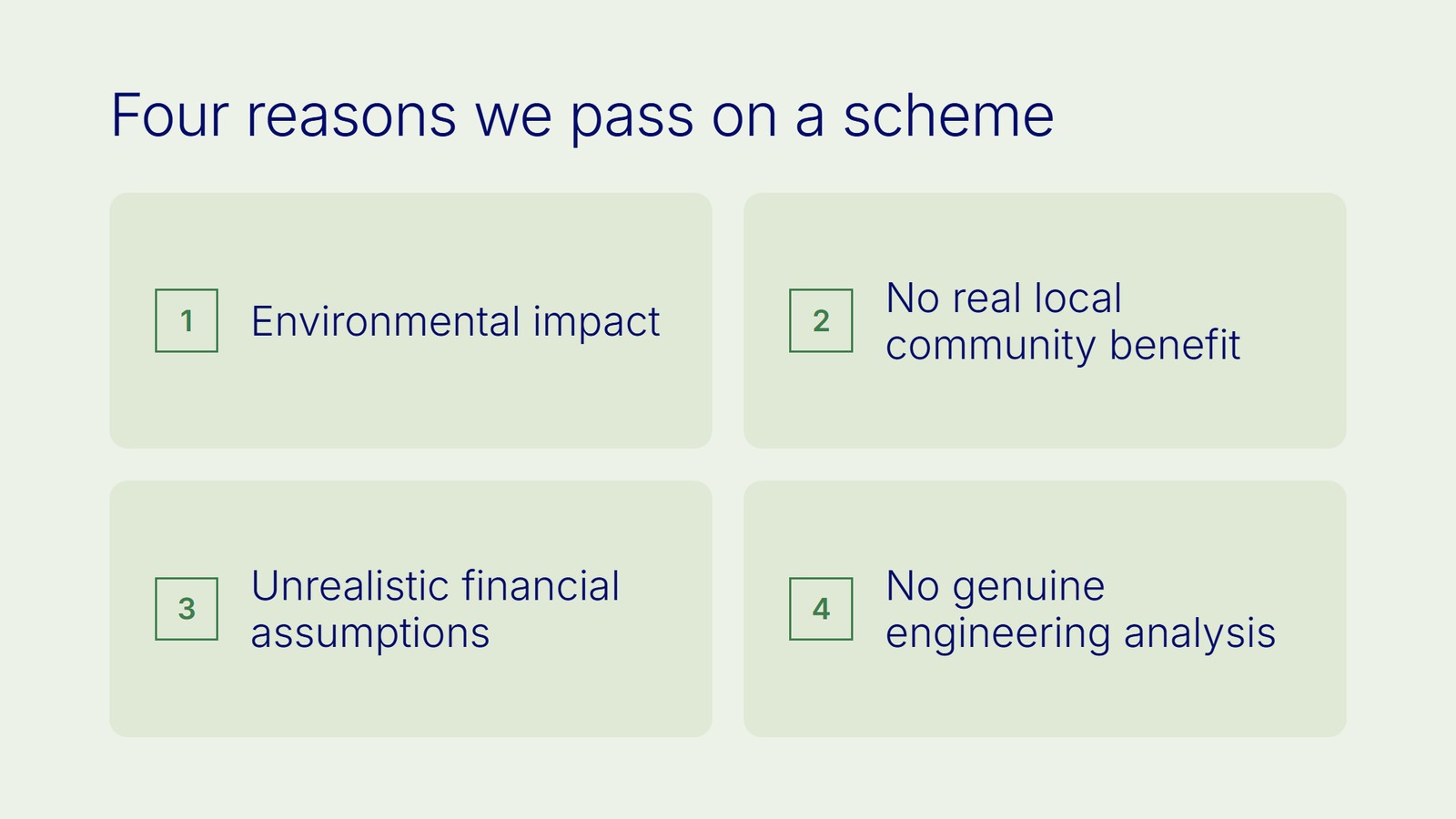
When we pass on a scheme, the reason is one of four.
Environmental impact: the scheme’s environmental cost outweighs what it delivers, however the return reads. Our standard is written into the financing terms at structuring and measured again in operation, across the five stages of our audit cycle: structuring, design, build, commissioning and operation. Backing a scheme that cannot carry that standard would mean signing indicators we already expect to miss.
No real local community benefit: the benefit to the people who live around the asset exists only on paper. An asset we operate depends on the place around it for its whole life. A scheme its neighbours have no reason to want is a scheme we would spend years defending.
Optimistic and unrealistic financial assumptions: the return holds only on the most favourable reading of rent, cost, occupancy or timing. Where operating records exist, we test the inputs against them. At Lynnhaven, a scheme we acquired in two phases, phase one’s actual rent, occupancy and maintenance numbers set the price we paid for phase two. A return that needs every assumption to land at once is a forecast of the best case.
No genuine engineering analysis: the financial model has no engineering underneath it. The Group began in 2007 as a mechanical, electrical and plumbing operation, and we read a scheme from its structure and services outward. A scheme that has not been engineered has not been priced, whatever its appraisal says.
On the assets we hold, our method runs past handover into audit and operation, and the fifth stage of our audit cycle compares annual operating data against the indicators an asset was financed to deliver.
That changes the arithmetic of saying yes. Every assumption we accept at structuring is one we answer for in operation, on our own data, for years. A weak input accepted at the start becomes a cost we carry long after the people who proposed it have moved on.
So the four reasons are self-protection as much as principle. Each one names a risk that would land on us, in the asset, after completion.
Holding the filter has a price, and it is worth stating plainly.
Passing means walking away from work our team has already spent time reading. It means telling a party who came to us in good faith that the scheme does not meet the standard, and that party may take the next scheme elsewhere. It means a slower pipeline, because structuring to this standard is slower than screening.
The compensation comes later: the assumptions a scheme we back carries into operation are ones we tested at the start.
For a partner bringing us a scheme, these four tests are the first conversation we will have, so they are worth having before the appraisal is finished. Bring the engineering with the financial model, the community case with the planning case, and the environmental cost with the return.
A scheme that clears all four moves on to feasibility. One that fails a test gets a clear reason, early.
Rami Saadi
CEO