Thirteen schemes, one model.
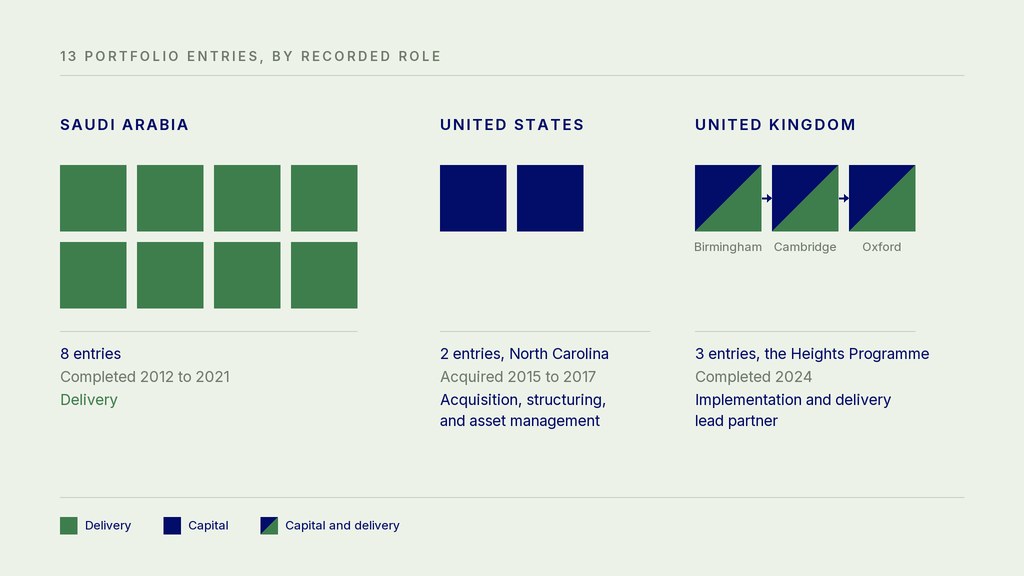
A portfolio page answers one question: what got built. A capital partner asks a different one. What does the list prove about the people who built it, and what does it not prove yet? The 13 entries on our portfolio page run from 2012 to 2024, across Saudi Arabia, the United States, and the United Kingdom. This piece reads them as evidence, including the parts where the evidence is thin.
The page filters by sector, which tells a reader what was built. What we did is on another line: the role recorded against each scheme.
Eight entries are in Saudi Arabia, completed between 2012 and 2021. In every one the recorded role is delivery: turnkey end to end, or civil and MEP works through to commissioning. The capital decisions sat with the client. Two entries are in North Carolina, acquired between 2015 and 2017, where the role is acquisition, structuring, and asset management. We bought and held those assets. We did not build them. Three entries are the Heights Programme in Birmingham, Cambridge, and Oxford, completed in 2024, where the role is implementation and delivery lead partner on the Heights Programme.
Each group proves something different. None of them proves everything.
They prove integration at the level of the building. Kingdom Tower Centre converted a car park into a 15,000 square metre mall and food court inside a live tower, with finishes, electrical, fire, and HVAC coordinated by one team, so the interfaces were resolved on site and stayed out of claim letters. At the Al Sheikh Foundation, the climate control, lighting, fire, and public address systems across 50,000 square metres were commissioned together. Marriott took the keys to 118 executive apartments only after the building had been commissioned as a whole against the operator's brand standard.
That is the delivery half of the model, proved repeatedly for clients who buy a working building and do not buy a shell, among them Saudi Aramco, the Ministry of Health, and Marriott. It says nothing about capital.
Read across the groups and one pattern repeats. Seven of the 13 entries record what was learned on one phase or scheme being carried into the next. In the first Ministry of Health programme, lessons from the earlier hospitals carried into the later ones. On the Saudi Aramco programme, the villa type was refined phase by phase and the later phases ran tighter than the first. Twelve family houses in North Carolina set the underwriting for what followed. At Lynnhaven, phase one's actual rent, occupancy, and maintenance numbers set the price paid for phase two. The Heights sequence ran Birmingham, then Cambridge, then Oxford, with the most planning-constrained site underwritten last, on the operating data of the other two.
That is the model in one sentence. Commit in sequence, and let the operating record price the next step. It held from rural hospitals to city housing, and across three countries, without changing shape.
Three limits are worth stating plainly, because a synthesis that only reports strengths is a brochure.
First, among the 13 entries published here, the Heights Programme is the one where the record shows capital structuring and delivery decisions running from the same room. The Saudi entries are delivery without the capital. The American entries are capital without the build. On this page, the full operator-partner model rests on one completed programme of three schemes.
Second, that programme completed in 2024. The fifth stage of our audit cycle, operation, compares annual operating data against the indicators an asset was financed to deliver. On the Heights schemes that record is still short against the life of the asset.
Third, the American holdings are seven-figure. They prove underwriting discipline in a new market. Scale there is still to be shown.
Every entry added to the page from here will carry its role, so it can be read the same way. The Heights operating record is what we intend to report against its indicators as the annual cycles accumulate. The measure of the model is how many schemes carry both halves of it.
Rami Saadi
CEO